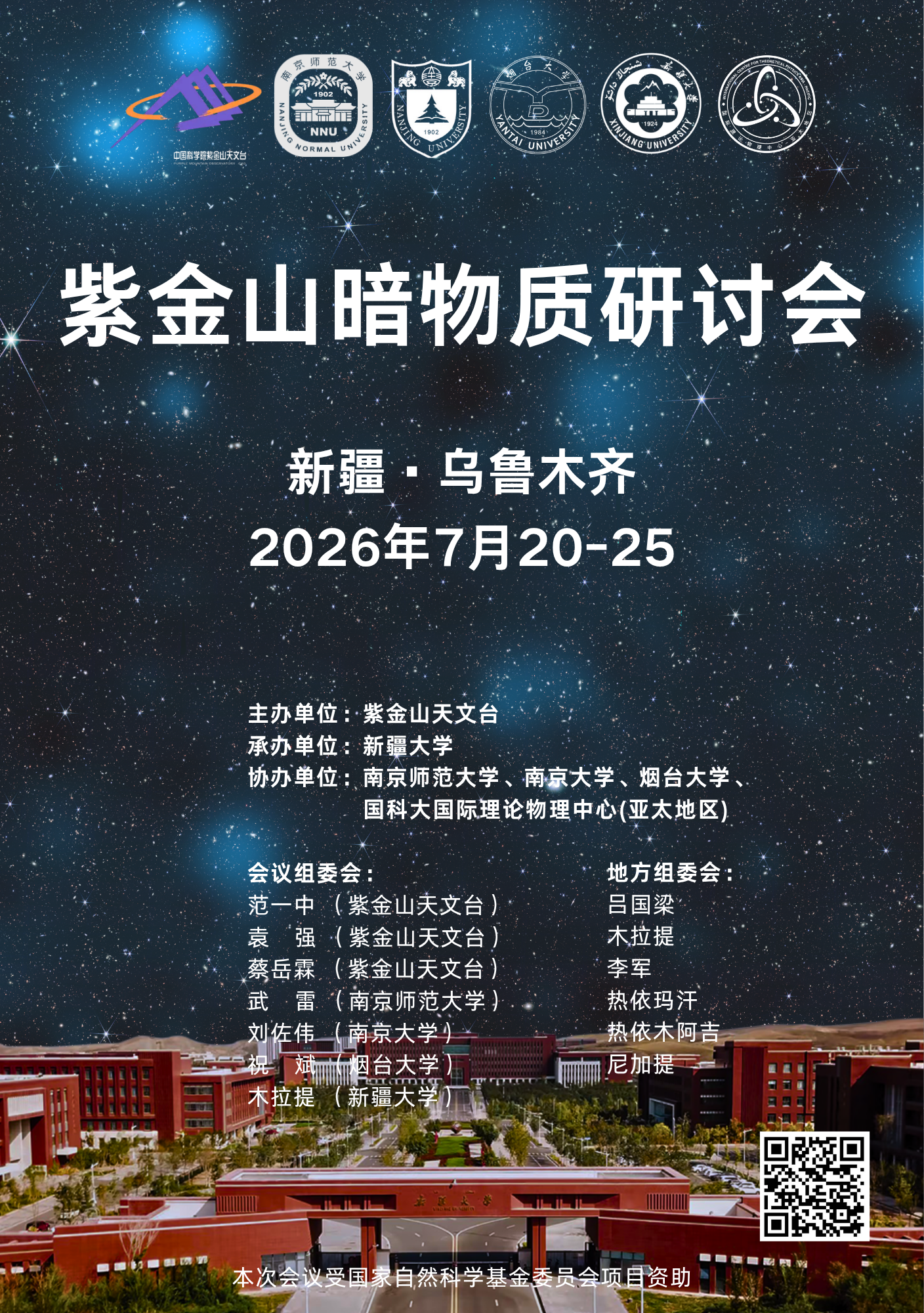
2026年紫金山暗物质研讨会

Asia/Shanghai
乌鲁木齐市明园新时代大酒店
Description

尊敬的各位同仁:

       暗物质研究是当代基础科学的核心议题之一,探索暗物质本质将进一步深化我们对物质起源、物理规律及宇宙演化的认知。近年来,我国在暗物质研究领域取得了国际领先的成果:成功发射首颗暗物质科学卫星DAMPE,建成世界最深地下实验室——锦屏地下实验室,开展CDEX 和PandaX 直接探测实验,利用FAST 射电望远镜研究暗物质属性,并在理论和暗物质探测领域涌现出一批突破性进展。为促进学科交叉、推动国内外合作,我们特举办紫金山暗物质研讨会。本系列研讨会由中国科学院暗物质与空间天文重点实验室2019 年发起,之后由南京师范大学在2023年、南京大学在2024 年、烟台大学于2025 年陆续举办。现已成为国内暗物质领域推动粒子理论、实验物理与天文观测等学科交叉的重要学术交流平台。

       为交流最新科研成果,我们将于2026年7月20日至25日在新疆乌鲁木齐举办2026年紫金山暗物质研讨会,诚邀本领域的实验和理论同行,共同探讨最新的暗物质探测结果、暗物质理论模型进展、新的暗物质探测方法、与暗物质相关的新物理研究进展,开展广泛而深入的学术讨论与思想碰撞,进一步促进理论物理与实验物理的融合,以期开启更多富有成效的科学合作,并取得更多有意义的研究成果。

       让我们在盛夏时节,相约美丽乌鲁木齐,共探物理前沿!

会议基本信息:

会议地点:乌鲁木齐市明园新时代大酒店

会议时间:2026年7月20日-25日(20日报到,21-24日会议,25日离会)

注册时间:截止日期为2026年6月20日。

注册费用:研究人员及博士后:1800元/人,学生及其他人员:1500元/人

食宿安排:本次会议统⼀安排住宿,会议期间交通费和⻝宿费⾃理。

主办单位:紫金山天文台

承办单位:新疆大学

协办单位:南京师范大学、南京大学、烟台大学、国科大国际理论物理中心(亚太地区)

会议组委会:

范一中  紫金山天文台

袁   强   紫金山天文台

蔡岳霖  紫金山天文台

武   雷  南京师范大学

刘佐伟  南京大学

祝   斌   烟台大学

木拉提·阿不都艾尼   新疆大学

地方组委会:吕国梁木拉提·阿不都艾尼、李军、热依玛汗、热依木阿吉、尼加提

会议联系人:木拉提·阿不都艾尼(17799755710mulati@xju.edu.cn)、郭怀珂(15010328750guohuaike@ucas.ac.cn)


会议联系人:木拉提·阿不都艾尼
Participants
    • 14:00
      报到、注册
    • 19:30
      晚餐
    • 1
      开幕式
    • 2
      CDEX暗物质实验进展与展望

      CDEX合作组使用高纯锗半导体探测器在位于四川西昌的中国锦屏地下实验室(CJPL)开展暗物质探测和无中微子双贝塔衰变实验研究。本报告将简要总结CDEX-1和CDEX-10两个实验阶段的物理成果,并重点介绍目前正在建设的CDEX-50暗物质实验,以及面向未来大型高纯锗阵列实验的一系列关键技术预研。

      Speaker: 丽桃 杨 (清华大学)
    • 3
      利用XENONnT寻找太阳中微子和暗物质

      对中微子和暗物质本性的理解是当今物理学和天文学最重要的问题之一。过去30多年来,科学家们发展了一套基于深地实验室的暗物质直接探测方法,测量灵敏度提升了几个数量级。XENONnT是运行于意大利格兰萨索地下实验室的液氙暗物质探测实验,其中6吨高纯氙原子用于捕捉暗物质和中微子产生的稀有信号。自运行以来,XENONnT已经获得采集了3批实验数据,总曝光量达到7.8吨x年。我将介绍XENONnT近期基于这些实验数据取得的太阳中微子和暗物质探测结果。

      Speaker: Fei Gao (Tsinghua University)
    • 4
      HADAR project

      高海拔天体辐射探测实验(HADAR)实验是新一代地面成像大气切伦科夫望远镜阵列。该实验首创采用半球形“水透镜”折射式光学系统,成功突破了传统反射式望远镜因相机自身的遮挡造成视场狭窄的瓶颈。凭借高海拔与创新技术,HADAR能实现~10 GeV的低探测阈能与60°×60°大视场的完美结合。它不仅能精确测量伽马射线点源,更将在多信使天文学时代,为实时捕捉伽马射线暴(GRB)等瞬变天体、寻找极端宇宙爆发的甚高能电磁对应体提供关键的观测数据。

      Speaker: 天禄 陈
    • 5
      The status and latest progresses of the DAMPE space mission
      Speaker: 川 岳 (紫金山天文台)
    • 11:40
      茶歇
    • 6
      SPECTRA室温暗光子探测实验

      我们将在报告中介绍一种面向暗光子暗物质探测的实验方案及最新原型机实验结果。该方法利用特殊光学结构增强潜在暗光子信号,并在室温条件下开展探测实验。报告将介绍实验中的弱光标定方法与多像素数据分析策略,以提升对微弱暗光子信号的识别能力。目前原型机已有三个月的曝光数据,尚未观测到具有统计显著性的信号,并据此对暗光子暗物质参数空间给出了约束。

      Speaker: 沪生 管 (西湖大学)
    • 7
      暗物质的引力波信号
      Speaker: 发朋 黄 (Sun Yat-sen University)
    • 8
      Key points in building supersymmetric models

      We summarize the key points in building realistic supersymmetric theories and discuss their implications at colliders.

      Speaker: Junjie Cao
    • 9
      轴子暗物质产生的数值模拟

      本报告主要汇报我们近几年在轴子暗物质相关拓扑缺陷研究中的进展。

      Speaker: 立功 边
    • 13:30
      午餐
    • 10
      Dark Photon Oscillations in Waveguide

      Dark photons, which can kinetically mix with ordinary photons, represent the simplest extension to the standard model. Detecting their oscillations with visible photons could provide crucial insights into the nature of dark matter and fundamental interactions beyond the standard model. We propose a novel laboratory-based approach to detect dark photon oscillations using a laser in an Optical Time-domai Reflectometry (OTDR) setup. The laser light propagating through the optical fiber undergoes oscillations with the dark photon, leading to measurable changes in the power flow. These oscillations can be precisely measured, leveraging its high sensitivity and efficiency in detecting small variations in the optical signal. This approach could provide a new avenue for probing dark photon oscillations in the laboratory and greatly improve the current experimental sensitivity to dark photon in a wide mass range.

      Speaker: 雯宇 王
    • 11
      Probing Ultralight Dark Matter with Laser Interferometers in Space

      Space-Based Laser Interferometers, LISA, Taiji and Tianqin, are not only sensitive to gravitational waves, but can also be able to probe ultralight dark matter. We shall report recent progresses on this topic.

      Speaker: Yong Tang (University of Chinese Academy of Sciences)
    • 12
      Chiral gravitational wave background from axion-like fields
      Speaker: 云龙 张 (中国科学院国家天文台)
    • 13
      极轻玻色子暗物质的强场效应和多信使观测
      Speaker: 一帆 陈 (李政道研究所)
    • 14
      Glueball Dark Matter:From Gravitational Waves to Direct Detection

      This talk presents a unified view of glueball dark matter and related composite states in confining dark Yang–Mills sectors. I first review lattice-informed effective descriptions of dark confinement and chiral dynamics, and show how the resulting phase transitions can generate potentially observable gravitational-wave signals, especially in fermionic and near-conformal regimes. I then discuss the non-perturbative thermal evolution of the dark gluon–glueball system, which leads to a controlled prediction for the relic abundance of scalar glueball dark matter. Building on this framework, I introduce composite glueball axion-like particles generated by a θ term and heavy fermion portals, yielding novel visible-sector couplings. Finally, I present recent progress on direct detection, where UV portal operators are matched to non-perturbative glueball amplitudes through a tensor-Pomeron-inspired EFT, opening a quantitative route to recoil searches and collider-consistent light-portal scenarios. Overall, this framework provides a coherent link between dark confinement, cosmological evolution, and experimental probes of strongly coupled dark sectors.

      Speaker: 王 WANG 志伟 ZHIWEI (University of Electronic Science and Technology of China (UESTC))
    • 17:10
      茶歇
    • 15
      Interpreting positional anomalies in the strong gravitational lensing system HS~0810+2554 with dark matter subhalos

      Self-bound dark matter subhalos are predicted to populate galactic halos in great abundance in the Cold Dark Matter (CDM) scenario. These substructures can leave observable imprints in strong gravitational lensing and have shown the ability to account for flux-ratio and image position anomalies in the multiple lensed images. In this paper, we utilize the dark matter subhalos to address the image positional anomalies of the two radio quads of HS 0810+2554 observed by the Very Long Baseline Interferometry. We model the lens using an elliptical power-law macromodel supplemented by a population of CDM subhalos from numerical simulations and perform a dual-source reconstruction to fit all eight radio images simultaneously. We find that subhalos below $10^{6}M_\odot$ induce astrometric shifts smaller than the measurement uncertainties, whereas more massive subhalos naturally generate the required milliarcsecond perturbations without significantly altering the global lens configuration. Including CDM subhalos improves the fit from $\chi=7.77$ for the pure macromodel to $\chi=1.27$. Our results show that the position anomalies of HS~0810+2554 can be explained within the CDM framework and do not by themselves necessarily require non-standard dark matter scenarios like fuzzy dark matter or angular complexity in the main lens. Instead, they provide a sharp and testable manifestation of the subhalo population predicted by CDM.

      Speaker: Qiang Yuan (Key Laboratory of Dark Matter and Space Astronomy)
    • 16
      Updated SN1987A constraints on dark gauge bosons

      We update the SN1987A constraints on the dark photon and $Z'$ bosons in the $U(1)_{B-L}$ model, in the approximation of one-pion exchange for nucleon-bremsstrahlung process. The dependence on the supernova profiles and geometric effects are taken into account. For the $U(1)_{L_\mu - L_\tau}$ model, the production of the $Z'$ boson is dominated by the lepton pair coalescence and semi-Compton processes.

      Speaker: Yongchao Zhang (Southeast University)
    • 17
      暗物质的宇宙学巡天探测研究

      宇宙学巡天观测是探测暗物质性质的重要手段。本报告将介绍利用lyman-alpha森林、矮星系丰度观测数据对模糊暗物质和温暗物质粒子质量等性质的最新探测结果,并讨论未来中国空间站巡天空间望远镜(CSST)的宇宙学观测对中微子质量和、极轻轴子轴子质量、原初黑洞等暗物质候选者的探测精度。

      Speaker: 岩 巩 (中国科学院国家天文台)
    • 18
      A novel axion misalignment mechanism
      Speaker: 伟 晁 (北京师范大学)
    • 19
      多信使宇宙研究
      Speaker: 一中 范 (紫金山天文台)
    • 19:30
      晚宴
    • 20
      Search for axionlike particles with spin-polarized system

      Ferromagnetic materials offer the unique advantages of an exceptionally high spin density and large remanent magnetization. When levitated, a ferromagnet can serve as an ultrasensitive magnetometer, while soft ferromagnetic materials with low remanence provide efficient magnetic shielding. In this talk, I will introduce a hybrid ferromagnetic platform that combines these complementary functionalities. The resulting system achieves ultrahigh magnetic sensitivity together with a broad detection bandwidth.

      Speaker: 伟 季
    • 21
      Composite Asymmetric Dark Matter with A Dark Photon Portal: Multimessenger Tests

      Composite asymmetric dark matter (ADM) is the framework that naturally explains the coincidence of the baryon density and the dark matter density of the Universe. Through a portal interaction sharing particle-antiparticle asymmetries in the Standard Model and dark sectors, dark matter particles, which are dark-sector counterparts of baryons, can decay into antineutrinos and dark-sector counterparts of mesons (dark mesons) or dark photon. Subsequent cascade decay of the dark mesons and the dark photon can also provide electromagnetic fluxes at late times of the Universe. The cosmic-ray constraints on the decaying dark matter with the mass of $1$--$10$ GeV has not been well studied. We perform comprehensive studies on the decay of the composite ADM by combining the astrophysical constraints from $e^\pm$ and $γ$-ray. The constraints from cosmic-ray positron measurements by AMS-02 are the most stringent at $\gtrsim 2$ GeV: a lifetime should be larger than the order of $10^{26}$ s, corresponding to the cutoff scale of the portal interaction of about $10^8 \text{--} 10^9 \, \mathrm{GeV}$. We also perform the dedicated analysis for the neutrino monoenergetic signals at Super-Kamiokande and Hyper-Kamiokande due to the atmospheric neutrino background in the energy range of our interest.

      Speaker: Takumi Kuwahara (Jilin U)
    • 22
      Sliding composite dark matter

      We present a scenario for GeV-scale thermal dark matter that can only be tested with accelerator experiments. Dark matter is composed of dark pions arising from a confining strong interaction in the dark sector. The thermal relic density is obtained through the interplay of up-scatterings of dark pions to heavier dark mesons (the dark counterparts of the kaons and $\eta$), and decays of the unstable dark $\eta$ to Standard Model particles. This mechanism is analogous to a playground slide, where one climbs up first and then slides down with a release of energy. We illustrate the scenario with a minimal model based on the $SU(3)/SO(3)$ coset, where dark matter is stabilized by a $U(1)$ flavor symmetry. The correct relic density is obtained with dark meson mass splittings of $10\%$ to $50\%$ and a dark-$\eta$ lifetime shorter than $10^3\,\mathrm{m}/c$. Direct and indirect dark matter searches are mostly ineffective, as a consequence of the charge conjugation symmetry of the stabilizing $U(1)$. The most striking signals arise at the LHC, from the production of dark showers containing long-lived dark $\eta$’s that decay to visible final states. These signatures crucially depend on the portal interaction connecting the dark sector to the Standard Model. We show that several well-known portals can complete the scenario above the weak scale, and outline the expected signals in each case.

      Speaker: Lingfeng Li (南京师范大学)
    • 23
      面向 sub-meV 暗物质搜索的波导探测器

      Sub-meV 质量区间是暗光子和轴子等超轻玻色暗物质的重要搜索窗口,但传统微波腔和反射盘面等探测方案在该区间的灵敏度受到限制。本报告介绍一种平行板波导的探测器,通过慢波响应和沿波导方向的相干积累,可在保持开放几何面积的同时实现导波增强。研究表明,低温铜波导可将暗光子混合参数的灵敏度推进到 $10^{-15}$ 量级。加入外加磁场后,该方案也可扩展用于 sub-meV 轴子探测。

      Speaker: Chuan-Yang Xing (China University of Petroleum)
    • 24
      Search for ultralight scalar dark matter with quadratic interactions

      In this talk, I will discuss about my recent work on the searches for the ultralight scalar dark matter with quadratic interactions with SM fields. This will lead to the effective interactions between the ultralight dark matter and the nucleon fields phi^2 N N/f below the QCD confinement scale, which can be thought as potential barrier for the dark matter wind in the presence of ordinary matter. When the potential barrier is large enough compared with the kinetic energy of the dark matter, the dark matter flux will bounce back from the ordinary object, as a result inducing a pressure force on the object. After taking into the constraints from Supernova cooling, BBN and gravitational inverse square law test, there exists parameter spaces in our model which can be searched for by utilizing this force effect on the experiment for the test of the weak equivalence principle.

      Speaker: Da Liu (Shandong University)
    • 11:20
      茶歇/合影
    • 25
      Heavy Axion from a Confining Mirror GUT

      We propose a new framework for solving the strong CP problem via a heavy axion, using mirror symmetry and grand unification. The mirror GUT sector remains unbroken and dynamically generates a calculable heavy mass scale via confinement without fine tuning. Models in this class feature a heavy axion, whose potential is less sensitive to Planck scale corrections, as well as a rich hidden sector from the confined mirror GUT. The solution to the strong CP problem remains unspoiled by the presence of additional phases in the GUT Yukawas, yet allowing the possibility of electric dipole moments within the reach of future experiments. Our proposal offers new directions in GUT model building, axion phenomenology, dark matter and cosmology.

      Speaker: 腾 马
    • 26
      Probing the wave nature of ultralight dark matter

      Many well-motivated UV theories contain bonsonic light degrees of freedom, which can be dark matter candidates. This leads to many new ideas and novel observables in recent years to probe new physics in astrophysical and laboratory setups alike. In this talk, I will briefly review a few examples in leveraging the wave-like features to test ultralight dark matter. These include the axion-induced supernova remnant radio echo, the soliton-imprinted galaxy rotation curves, axion-induced neutron star X-ray signals. I will end with a new axion-photon resonant conversion mechanism induced by spatially varying magnetic field background and show its phenomenological consequences to the LSTW experiments and solar axion searches.

      Speaker: 晨 孙
    • 27
      Problems of SIMP dark matter and Potential Solutions

      In the early universe, dark matter (DM) may undergo freeze-out to reach its observed relic abundance. Unlike conventional WIMPs, SIMPs (Strongly Interacting Massive Particles) achieve this via efficient number-changing annihilations, motivated by astrophysical small-scale structure puzzles. However, SIMPs face two critical hurdles: (i) the strong couplings needed for successful freeze-out may break perturbativity, and (ii) kinetic equilibrium with the thermal bath is crucial to dissipate energy. My talk presents our solutions, showing that both issues can be naturally resolved in some dark QCD models.

      Speaker: Xiaoyong Chu (University of Chinese Academy of Sciences)
    • 28
      Paleodetector Bounds on Cosmic-Ray-Boosted Dark Matter

      We present the first dedicated analysis of cosmic-ray boosted dark matter (CRDM) in paleo detectors. Owing to their large kinetic energies, CRDM particles generate nuclear-recoil tracks that extend to substantially larger lengths than those produced by dominant backgrounds from neutrinos and intrinsic radioactivity. Combined with the ultra-large effective geological exposure of $10^5$ t yr, paleo detectors provide a uniquely sensitive probe of sub-GeV DM. Considering both constant and vector-mediator interactions, we find that paleo detectors improve the sensitivity to the DM-proton scattering cross section by one to two orders of magnitude compared with the latest XENONnT limits.

      Speaker: 金伟 王 (电子科技大学)
    • 29
      Axion Dark Matter from Parametric Resonance during the QCD Phase Transition
      Speaker: 峤立 杨 (暨南大学)
    • 13:30
      午餐
    • 30
      Statistical Cosmological Seesaw and the Emergent 6 TeV Electroweak Cutoff

      The extreme disparity between the Planck-scale vacuum energy and the observed cosmological constant, alongside the \textit{ad hoc} TeV-scale cutoff required to stabilize the electroweak hierarchy, present profound interrelated crises in fundamental physics. We propose an effective field theory wherein continuous spacetime emerges from a discrete Poisson substrate governed by a non-linear exponential capacity measure. Applying It\^{o}'s stochastic calculus, we mathematically demonstrate a statistical bifurcation: the deterministic mean condenses to define the classical metric background, while the variance of the zero-mean Gaussian geometric noise escapes linear cancellation. This rectified variance generates a macroscopic drift that identically manifests as the dark energy density ($\rho_\Lambda = \sigma_{\text{bulk}}^2/2\kappa$). Diluting the trans-Planckian boundary variance by the covariant Bekenstein-Hawking entropy of the observable universe ($N \sim 10^{122}$), we rigorously map the bulk variance to a four-dimensional momentum phase-space integral. This yields an exact, parameter-free continuous field cutoff at $E_{\text{cutoff}} \approx 6 \text{ TeV}$. This establishes the electroweak scale as a robust macroscopic holographic projection of the Planck limit, providing a falsifiable prediction of a universal non-perturbative exponential softening in high-$p_T$ scattering cross-sections at contemporary colliders.

      Speaker: 思学 秦
    • 31
      Coscattering Dark Matter in the Inverse Scotogenic Model

      The Scotogenic mechanism is an appealing pathway to naturally explain the common origin of dark matter and tiny neutrino mass. However, the conventional scotogenic dark matter usually suffers stringent constraints from the non-observation of lepton flavor violation and direct detection. To generate the non-zero neutrino masses, at least two generations of dark particles are required. For example, two real scalar singlets $\phi_1$ and $\phi_2$ are involved in the inverse scotogenic model, which are odd under the $Z_2$ symmetry. In this paper, we consider the masses of dark scalars are nearly degenerate $m_{\phi_1}\lesssim m_{\phi_2}$, which opens new viable pathway for the generation of dark matter $\phi_1$, such as the coscattering process $\phi_1\text{SM}\to \phi_2 \text{SM}$ and coannihilation processes $\phi_1 \phi_2 \to \text{SM~SM}$ via the Higgs portal or Yukawa portal interactions. We explore the parameter space to produce the correct relic density through coscattering, as well as the contrastive coannihilation channel. We then comprehensively study the constraints of dark matter from Higgs decay, direct detection, and indirect detection. For the heavier dark scalar, the three-body decay $\phi_2\to\phi_1 f\bar{f}$ not only alerts the predictions of big bang nucleosynthesis and cosmic microwave background, but also leads to the observable displaced vertex signature at colliders.

      Speaker: 志龙 韩 (济南大学)
    • 32
      基于旋转扭秤的暗物质散射截面探测

      针对质量在 10⁻³ 到 1 eV 范围内的轻质量暗物质,其德布罗意波长较长,能够与宏观物体发生相干散射,从而极大地增强散射截面和产生的加速度。为此,论文设计了一种特殊的扭秤,其测试质量块由一个实心立方体和一个空心立方壳组成,两者质量相同但几何尺寸差异巨大。由于相干效应与物体尺寸相关,暗物质“风”会对这两个测试质量块产生不同的加速度,进而形成一个可测量的净力矩。通过重新分析现有等效原理实验的灵敏度,该方案在 10⁻³ 到 1 eV 的质量范围内,对暗物质-核子散射截面给出了迄今为止最严格的直接探测限制,其灵敏度可达约 10⁻⁵¹ cm²。这项工作为探测这一尚未被充分探索的轻质量暗物质区域开辟了新的途径。

      Speaker: 琳 邾
    • 33
      基于空间引力波探测检验暗物质研究

      Cold dark matter is one of the most compelling candidates for dark matter, and its intrinsic properties suggest that it can accumulate near the central supermassive black holes of galaxies, forming dense dark matter halos. Space-based gravitational wave (GW) detectors, with their high sensitivity, offer a promising avenue to probe the existence of dark matter through its effects on GW signals. In this work, we adopt the Navarro-Frenk-White (NFW) profile as the initial dark matter halo model and consider the adiabatic formation of a static, spherically symmetric black hole within the halo. In the final state spacetime, we took into account the gravitational perturbation effect of the dark matter halo, which resulted in the final spacetime metric being different from the Schwarzschild metric. Based on the relativistic dynamics in the resulting spacetime, we calculate the dark matter density and velocity distributions in the vicinity of the black hole. In this process, we employ the near-field approximation to derive analytical expressions for the distribution function of the NFW halo. Furthermore, we assess the dynamical friction exerted by the dark matter halo on orbiting bodies near the black hole, and investigate its impact on the orbital evolution and GW waveforms of extreme mass-ratio inspiral systems. Our results indicate that, in certain scenarios, the presence of a dark matter halo can lead to modifications in the phase of the emitted GWs.

      Speaker: 盼盼 王
    • 34
      Triplet fermion WIMP dark matter in the general supersymmetric Georgi-Machacek model

      The supersymmetric custodial triplet model (SCTM), which is a fully supersymmetric generalization of the Georgi-Machacek (GM) model, is constructed by extending the Higgs sector of the minimal supersymmetric standard model by three triplet chiral superfields with hypercharge $Y = 0, \pm1$, in order to maintain the holomorphy of the superpotential and satisfy the requirements of anomaly cancellation.
      The global $SU(2)_L \otimes SU(2)_R$ symmetry has to be respected for the superpotential and the soft supersymmetry-breaking sector, where the former is only broken by the Yukawa couplings, while the latter is broken spontaneously to the custodial $SU(2)_V$ symmetry after electroweak symmetry breaking, similar to the GM model.
      The ensuing complicated spectrum not only gives rise to rich collider phenomenology but also provides more viable weakly interacting massive particle (WIMP) dark matter (DM) candidates.
      We explore the viability of WIMP solutions for DM in the SCTM by considering the increasingly stringent constraints from direct-detection DM experiments. Our numerical simulations show that a significant portion of the SCTM parameter space remains viable despite these constraints.

      Speaker: Liangliang Shang
    • 35
      Dark matter study at BESIII

      Direct detection experiments have imposed stringent experimental constraints on dark matter with masses greater than 1 GeV, while much looser limits apply to lighter sub-GeV dark matter due to their non-relativistic velocities, which prevent them from reaching the detection thresholds of most traditional experimental methods. BESIII is a general-purpose detector operating at BEPCII with center-of-mass energies of a few GeV, providing unique opportunities to study sub-GeV dark matter. By utilizing the known initial four-momentum and full reconstruction capabilities, BESIII can employ missing mass or missing energy techniques to search for invisible dark matter generated from the collider. In this talk, I will present some of the latest results on dark matter from BESIII, including searches for $\eta\to\pi^0+\rm{invisible}$, $J/\psi\to\phi+\rm{invisible}$, and $K^0_S\to\rm{invisible}$. Additionally, I will report on the study of exotic dark matter carrying a baryon number in $\Xi^-\to\pi^-+\rm{invisible}$. These results can provide unique and stringent constraints on sub-GeV dark matter.

      Speaker: Zhijun Li (Sun Yat-sen University)
    • 17:20
      茶歇
    • 36
      Composite dark matter
      Speaker: Haiying Cai (jxnu)
    • 37
      Scattering of non-relativistic finite- size particles and puffy dark matter direct detection

      In this work we consider the scattering between non-relativistic particles with different finite sizes. We first calculate their interaction potential and apply the partial wave method to obtain their scattering cross section. Our findings show that the particle size can significantly affect the scattering between non-relativistic particles. Then we apply such a study to direct detection of puffy dark matter. We find that the finite size of the target nucleus may introduce non-perturbative effects that differ from the scenario of point-like dark matter. For large-size dark matter particles, this non-perturbative regime in the dark matter–nucleus scattering cross section effectively disappears; while for small values of the size-to-range ratio in the scattering process, a significant non-perturbative regime can maintain. Finally, for the direct detection of nugget-type puffy dark matter with a small number of constituent particles, we find that the stability conditions for the formation of bound-state dark matter can provide constraints on the dark matter–nucleus scattering cross section.

      Speaker: 武龙 许 (成都工业学院)
    • 38
      Big Bang Nucleosynthesis as a Precision Probe of New Physics: Heavy Neutral Leptons, Primordial Black Holes, and Others

      Big Bang Nucleosynthesis (BBN) provides a precision laboratory for the MeV-era Universe, turning light-element abundances and the radiation content into stringent tests of new physics.
      I will review the key BBN ingredients and emphasize how departures from standard expansion and neutron–proton conversion translate into constraints on exotic energy injection, and the impact of hadronic decay products injected at the relevant epoch: mesons and (anti-)nucleons can drive efficient nonstandard $n \leftrightarrow p$ conversion and distort the freeze-out proton–neutron ratio, thereby shifting the primordial helium abundance $Y_\mathrm{P}$.

      Firstly, I discuss MeV–GeV heavy neutral leptons (HNLs).
      Using recent cosmological analyses that consistently track both the background evolution and meson-driven $n \leftrightarrow p$ conversion, I show that introducing sizable “dark” decay channels does not generically weaken BBN bounds.
      Instead, dark decays typically increase the dark-sector energy density around BBN, enhancing deviations in $Y_P$ and $\Delta N_\mathrm{eff}$, and can even strengthen exclusions in regions targeted by laboratory experiments.

      Secondly, I present updated BBN constraints on primordial black holes (PBHs) evaporating before nucleosynthesis.
      A careful treatment of hadronization and meson/nucleon effects implies that observable BBN sensitivity requires $m_\mathrm{PBH}\gtrsim 10^9$ g, with limits on the initial PBH fraction $\beta \sim 10^{-17} – 10^{-19}$ for $m_\mathrm{PBH} \in [10^9, 10^{10}]~\mathrm{g}$.

      In future work, we will continue to leverage BBN as a precision probe to explore a broader range of dark-matter scenarios and other manifestations of new physics.

      Speaker: Quan-feng Wu (Purple Mountain Observatory, Chinese Academy of Sciences)
    • 39
      Search for Ultralight Dark Matter with Quantum Magnetometry in the Earth’s Cavity

      Ultralight dark matter candidates, such as axions and dark photons, are leading dark matter candidates. They may couple feebly to photons, sourcing oscillating electromagnetic signals in the Earth's conducting cavity formed between the ground and the ionosphere, providing detectable magnetic field signatures at wavelengths above the Earth's size. We carry out a project aiming to search for new physics using an unshielded high-sensitivity atomic magnetometer, termed the Geomagnetic Probe for nEw physiCS (GPEX). In this work, we report our first search for axion and dark photon dark matter, conducted in the desert of XiaoDushan in Gansu Province, China. Analysis of the collection of one-hour data shows no robust evidence for axion- or dark photon-induced magnetic signals. Correspondingly, we set the constraints on the axion-photon coupling with $g_{a\gamma\gamma} < 7\times10^{-10}\, \mathrm{GeV^{-1}}$ and the dark photon kinetic-mixing parameter $\epsilon < 2\times10^{-6}$ in the mass range $3.5 \times 10^{-16}\, \mathrm{eV} \sim 1.8 \times 10^{-14}\, \mathrm{eV}$. The sensitivities improve upon those achieved by the dedicated SNIPE-Hunt experiments by more than one order of magnitude and a factor of three, respectively. Our findings demonstrate the feasibility of using ground-based quantum magnetic sensors for ultralight dark matter searches. Future networks of such detectors operating over extended periods could improve the sensitivity by about six orders of magnitude.

      Speaker: Yuanlin(远林) Gong(龚) (Nanjing Normal University)
    • 40
      Reactor Nuclear De-excitation as a Probe of MeV-Scale Dark Sectors

      Nuclear reactors provide intense neutron-capture environments and can act as controlled terrestrial sources of MeV-scale dark-sector particles. In this talk, I will discuss reactor-produced dark photons and dark matter from nuclear de-excitation. In the kinetically mixed vector-portal framework, excited nuclei can emit an on-shell vector mediator via N* -> N V, which can either decay visibly or invisibly into a dark matter pair. The visible-decay channel probes MeV-scale dark photons, while the invisible-decay channel produces a flux of sub-MeV dark matter.

      Speaker: Yuanchao Lou (Nanjing normal university)
    • 41
      Constraints on Axion-Like Particles with the Silicon Detector at a Nuclear Reactor

      Axion and axion-like particles (ALPs), predicted in various extensions of the Standard Model, can be abundantly produced in nuclear reactors via the Primakoff process. In this work, we explore the detection of ALPs in silicon detectors through plasmon excitations. Owing to their relativistic nature, reactor-produced ALPs can efficiently excite plasmon resonances, while the accompanying energetic photon typically escapes from the thin detector without depositing an appreciable amount of energy. Utilizing the data from the Connie and Atucha-II experiments, we set the 90\% confidence level upper limits on the ALP-photon coupling $g_{a\gamma\gamma}$ over the axion mass range $0.1-100$ keV. We further show that, for an exposure of 30 kg$\cdot$yr, the projected sensitivity of vIOLETA exceeds the current NEON limit by a factor of three in the same mass range. This improvement would expand the explored region of the QCD axion and ALP parameter space.

      Speaker: 文娜 杨 (南京师范大学)
    • 19:30
      晚餐
    • 42
      利用Lya森林的再电离热遗迹效应限制温暗物质性质

      宇宙中性氢气体被电离的同时会被加热,其效应会持续到再电离结束后的时期。由于再电离高度非均匀性,再电离结束后的中性氢气体性质会受到重要影响,Lyα森林功率谱在大尺度上因此改变可达50%,即“再电离热余晖效应”。通过这一效应,温暗物质在小尺度上对于电离源的影响会转变为Lyα森林功率谱在大尺度上的调制,从而有希望通过DESI的Lyα森林功率谱测量限制温暗物质的性质。我们在报告中预测利用DESI限制温暗物质质量的精度。

      Speaker: 奕 茅 (清华大学)
    • 43
      大型光谱巡天时代下银河系结构研究

      受限于银河系内部视角和观测能力,人们对银河系内物质分布和整体结构长期缺乏清晰的认识。幸运的是,过去10年相继开展的大型恒星光谱巡天为我们认识银河系打开了新的窗口。在本次报告中,我将简要回顾过去10年基于恒星光谱巡天,银河系结构认识的重要演变,包括银河系盘的径向结构偏离单指数的新发现,以及这些新认知对银河系其他领域研究的影响。

      Speaker: 建辉 连
    • 44
      A phase-space view of dark matter halos: assembly, structure, and response to baryonic feedback

      This talk presents a phase-space perspective on dark matter halo assembly and evolution. First, we show that large-scale environments shape the infall orbit distributions of subhalos, setting the initial conditions for halo assembly. Second, we demonstrate that the dynamical relaxation of accreted material gives rise to universal phase-space scaling relations and distribution functions. Finally, we present a novel phase-space approach to model halo responses to baryonic feedback, and show how it accounts for the formation of dark-matter-deficient galaxies.

      Speaker: Zhaozhou Li (Nanjing University)
    • 45
      人机协同驱动的宇宙学数值模拟和暗物质探索

      现代宇宙学的研究中,暗物质的性质是一个研究重点,使用宇宙学数值模拟技术探讨宇宙大尺度结构的演化以及暗物质的性质是一个被证明非常有效的技术。然而,突破标准模型的宇宙学数值模拟需要在现有宇宙学数值模拟的框架上做诸多修正,技术复杂,研究门槛高,有大量的暗物质模型因此无法得到有效验证。近年来,以大语言模型为代表的人工智能技术的发展对科学研究带来了深刻的变革,例如DeepSeek等大语言模型已经迅速普及到生活中的各个领域。我们基于DeepSeek大语言模型,开发了针对宇宙学数值模拟的智能体,该智能体使用多智能体协同技术,兼有文献调研,代码分析,形成报告等功能,可以让用户以一句话就完成复杂的宇宙学数值模拟软件的生成。我们经过评估发现,该智能体可以有效避免幻觉产生,形成有实际生产能力的工作指南。使用这些工作指南,我们自动化开发了包括SIDM,WDM等模型在内的宇宙学数值模拟软件。在开发效率方面,和有经验的开发者对比,该智能体的开发效率高两个数量级。该智能体的应用将引发数值模拟研究暗物质性质的重大变革,成百上千个过去未能得到模拟检验的模型将可获得检验,该领域中最消耗时间和经验的部分已被突破。我们认为该研究中产生的人机协同方法,可扩展到更加广泛的研究领域,或将带来研究范式的深刻变革。

      Speaker: 佳骏 张 (中国科学院上海天文台)
    • 46
      TBD
      Speaker: 鑫 王 (中国科学院大学)
    • 11:20
      茶歇
    • 47
      Mapping the Dark Universe with Weak Lensing

      TBD

      Speaker: Prof. Huanyuan Shan (Shanghai Astronomical Observatory, CAS)
    • 48
      Data driven measurement of the Mikly Way halo mass
      Speaker: 家信 韩 (李政道研究所)
    • 49
      Path Measures for Stochastic Galaxy Formation on Layered Halo Graphs

      Galaxy formation, viewed as an inference problem from incomplete information, is inherently stochastic. Reducing the full simulation state to a coarse-grained set of variables integrates out unresolved degrees of freedom, motivating an effective stochastic description of galaxy formation in reduced variables. Existing approaches have achieved substantial predictive success, but generally lack a unified statistical framework for trajectory-level galaxy assembly and history-conditioned fluctuations. We introduce a Graph Path Likelihood Model that formulates galaxy assembly histories as stochastic dynamical trajectories on hierarchical halo merger graphs, where temporal edges encode causal transport and coeval host edges encode environmental conditioning. Within this formulation, galaxy evolution is described by graph-conditioned path measures and effective actions, from which observables, likelihoods, and response diagnostics emerge from a common probabilistic description. As a first realization, we train a graph neural likelihood model for stellar and gas mass assembly histories on layered halo graphs extracted from hydrodynamic simulations. We show that it reproduces the main statistics of these histories while capturing environmentally conditioned correlated fluctuations. The path measure formulation also provides a natural setting for example fixed-graph applications, which we illustrate with the fraction of dark-matter-deficient galaxies, controlled gas-response deformations, and nonequilibrium diagnostics of environmentally dependent evolution. In particular, the present construction also admits extensions in which merger-history statistics and baryonic evolution are treated within a unified probabilistic description, potentially enabling studies of how graph structure, assembly histories, and galaxy observables respond jointly to variations in the underlying theory.

      Speaker: Daneng Yang (Purple Mountain Observatory, Chinese Academy of Sciences, Nanjing 210023, China)
    • 50
      利用球状星团潮汐流研究银晕暗物质密度轮廓

      银晕中由球状星团潮汐瓦解形成的星流结构相对脆弱,对银河系引力势高度敏感,因此是约束引力势模型的理想示踪体。本研究结合暗能量巡天(DES)与Pan-STARRS项目的测光数据,以及Gaia卫星的天体测量数据,采用改进的匹配滤波方法,成功证认了NGC 5466星流中的194颗高置信度成员星。通过将观测到的星流结构与在不同引力势参数下生成的模拟星流进行对比,我们估算出银晕暗物质密度轮廓接近球形(轴比 q≈1.02)。

      Speaker: Jingkun Zhao (National Astronomical Observatories of China)
    • 51
      21-cm and gravitational-wave probes of ultralight dark matter

      Ultralight scalar field dark matter is one of the most popular dark matter candidates today. It naturally predicts a kination phase in the early Universe while affecting the formation of cosmic structures during the matter-dominated era. In this talk, I will present new theoretical progress and discuss the 21-cm and gravitational-wave probes of ultralight dark matter.

      Speaker: Bohua Li (Guangxi University)
    • 13:30
      午餐
    • 52
      Probing the Galactic-Center GeV Excess Using Continuous Gravitational-Wave Searches
      Speaker: 悦 赵 (香港科技大学)
    • 53
      New gravitational-wave probes of dark matter using data from LIGO's fourth observing run

      Dark matter could compose ~80% of all matter in the universe, and yet it is completely invisible to us. Despite decades of experiments designed to detect dark matter, and numerous models for potential dark matter particles, no concrete evidence has been put forward to support the existence of beyond standard-model physics. Because of this, it is worth asking whether approaching the detection of dark matter from a different point of view, that is, via gravitational waves, could provide some insight into explaining the origin of dark matter. In this talk, I will highlight recent search results that use gravitational-wave interferometers to search for dark matter in two forms: ultralight particle dark matter and sub-solar mass primordial black holes. While not designed to search for dark matter, gravitational-wave detectors can robustly probe a variety of dark-matter models simultaneously, without affecting their sensitivity to canonical gravitational-wave sources, and put competitive and sometimes even stronger constraints than those from other experiments designed to search for dark matter.

      Speaker: Andrew Miller (ICTP - AP / University Chinese Academy of Sciences)
    • 54
      Dark Matter Direct Detection at LIGO-Virgo-KAGRA
      Speaker: 怀珂 郭 (国科大国际理论物理中心)
    • 55
      Gravitational Wave Constraints on the Quasi-Highest Energy Scale of the Non-singular Universe
      Speaker: 昌鸿 李 (云南大学)
    • 56
      Constraints on Dark Matter and High-Frequency Gravitational Waves from Diffuse Galactic Radio Observations
      Speaker: 然 丁
    • 17:10
      茶歇
    • 57
      百万太阳质量尺度上暗物质是波而非粒子:Cusp构型透镜化类星体作为暗物质显微镜 (Dark Matter Is a Wave, Not a Particle: Cusp-Configuration Lensed Quasars as Million-Solar-Mass Dark Matter Microscopes)

      Understanding the nature of dark matter remains a central challenge in physics. Flux-ratio anomalies in strongly lensed quasars provide one of the few observational probes of dark matter structure down to ∼ 10⁶ M⊙. Here we present the first population-level statistical analysis of cusp-configuration flux-ratio anomalies using the latest set of microlensing-free measurements from 17 quadruply imaged quasars, including new JWST observations. We introduce a macromodel-independent framework that maps lens configurations into a unified cusp-parameter–opening-angle $R_{\rm cusp}-\phi$ parameter space, enabling direct comparison across dark matter scenarios. We identify a specific geometric class of cusp lenses in which flux-ratio anomalies are intrinsically sensitive to dark matter microphysics and cannot be absorbed by macromodel complexity. Bayesian model comparison reveals decisive evidence (Bayes factor > 100) favouring fuzzy dark matter over both cold and self-interacting dark matter, which represents the strongest gravitational-lensing evidence for wave-like dark matter and makes falsifiable predictions for forthcoming surveys.

      Speaker: Siyuan Hou (Purple Mountain Observatory, Chinese Academy of Sciences (PMO, CAS))
    • 58
      银河系动力学不支持修改引力的证据

      暗物质和修正引力长期以来都是解释星系旋转曲线异常的重要方案,但二者在银河系尺度上仍存在明显争议。我们结合银河系径向旋转曲线、Gaia 数据揭示的垂直相空间螺旋结构,以及最新的断裂指数恒星盘模型,同时约束银河系的径向和垂直引力场。研究发现,MOND 和 STVG 等修正引力模型虽然能够解释部分局部垂直引力势,但无法同时匹配银河系旋转曲线和垂直动力学观测,可能存在结构性矛盾。相比之下,包含近球形暗物质晕的冷暗物质模型能够更自然地解释这些观测结果。统计分析表明,MOND 被超过 $13\sigma$ 的显著性排斥,STVG 也受到超过 $4\sigma$ 的限制。该研究说明,当前银河系动力学更支持暗物质模型。

      Speaker: Zheng-Long Wang
    • 59
      Constraining Ultralight Scalar Dark Matter in the Galactic Center with the S2 Orbit

      The dense environment of our Galactic Center (GC) offers a unique laboratory for probing ultralight dark matter (ULDM). We explore the prospect of detecting a scalar ULDM field through its effects on the orbital dynamics of S-stars around the supermassive black hole in the GC, Sgr A. We consider both linear and quadratic couplings between the real scalar field ϕ and Standard Model particles, and analyze two representative ULDM structures: the scalar gravitational atom and the spherical soliton. We find that quadratic coupling induces a non-oscillatory perturbation, leading to a long-term secular orbital evolution. We use the observed periastron precession rate of S2 star to put stringent constraints on the total ULDM mass in the GC and the quadratic coupling constant. For the gravitational atom |211⟩ state, we constrain the mass ratio of ULDM to Sgr A to β ≲ 1e-3 at m ∼ 1e-18 eV, and for the spherical soliton which extends to ∼ 0.2 pc, the mass ratio is limited to β ≲ 1 at m ∼ 3e-20 eV. Notably, the resulting limits on the quadratic coupling constant surpass current bounds in the mass range 1e-20 eV ≲ m ≲ 1e-18 eV.

      Speaker: 江川 于 (北京大学)
    • 60
      Distinguishing the nature of dark matter by mapping cosmic filaments from Lyman-alpha emission(通过Lyman alpha发射线绘制宇宙纤维结构以甄别暗物质本质)

      The standard $\Lambda$CDM cosmological model predicts that cosmic filaments are highly clumpy, whereas warm dark matter -- invoked to address small-scale challenges in $\Lambda$CDM -- produces filaments that are noticeably smoother and less structured. In this work, we investigate the potential of Lyman $\alpha$ (Ly$\alpha$) emission to trace cosmic filaments at redshifts $z=2.5$ and $z=4$, and assess their potential for constraining the nature of dark matter. Our analysis shows that Ly$\alpha$ filaments provide a promising observational probe of dark matter: at $z=4$, differences in filament smoothness and surface brightness serve as distinctive signatures between models. Looking ahead, the upcoming generation of 30-meter class telescopes will be critical for enabling these measurements, offering a compelling opportunity to distinguish the nature of dark matter by mapping the structure of cosmic filaments.

      Speaker: 奕舟 刘 (北京师范大学)
    • 61
      Exploring Dark Matter Physics through Weak Lensing Surveys

      Dark matter (DM) is a key component of modern cosmology, driving structure formation and influencing the evolution of the Universe. Observations of large-scale structure therefore provide a powerful avenue for probing the fundamental properties of DM. If DM has any non-gravitational interactions, these will modify the thermal and perturbation history of the early Universe, leaving characteristic imprints on the cosmic microwave background (CMB) and weak gravitational lensing signals. Precise surveys can thus be used to test the nature of DM.
      In this talk, I will discuss three classes of DM models: Mirror Twin Higgs DM, DM–baryon interactions, and DM–neutrino interactions. All three alter the evolution of cosmological perturbations in the early Universe. By combining these theoretical models with N-body simulations to capture nonlinear structure formation, we can use weak lensing surveys to probe the particle nature of DM.

      Speaker: 磊 祖
    • 62
      Supernova cooling from neutrino-devouring dark matter
      Speaker: 宇根 林 (中国科学院理论物理研究所)
    • 63
      Search for Dark Matter via Precision Force Measurements

      While astronomical observations confirm the existence of dark matter, its physical nature remains unknown. For ultralight dark matter (ULDM), its large number density can induce a continuous force on macroscopic targets, allowing detection through precision acceleration measurements. In particular, when the ULDM wavelength matches the target's scale, coherent scattering from all nucleons quadratically enhances the signal.
      Here, we analyze data from the MICROSCOPE space mission to constrain the dark matter–nucleon scattering cross section. Designed to test the Weak Equivalence Principle by measuring the differential acceleration of two concentric cylinders with exceptional precision, MICROSCOPE is also uniquely sensitive to a potential dark-matter wind. We demonstrate that the nested-cylinder geometry of MICROSCOPE gives rise to a novel interference effect in ULDM wave scattering, where the scattering amplitudes from the two cylinders interfere and redistribute the induced force. By developing a comprehensive theoretical framework to model this signal, we analyze the MICROSCOPE data to set leading constraints on the dark matter–nucleon coupling for ULDM masses in the range of ${10}^{-3}–{10}^{-2}\ {\rm eV}$, reaching cross sections as small as ${10}^{-52}\ {\rm cm}^2$ [1].

      [1] Macroscopic quantum interference in dark matter wave scattering with MICROSCOPE, Cheng-Tao Fu, Pengshun Luo, Rui Luo, Jie Sheng, Chuan-Yang Xing, arXiv:2606.07008.

      Speaker: 承涛 符
    • 19:30
      晚餐
    • 64
      Recent Results from the PandaX Experiment

      PandaX is a dark matter and neutrino experiment at the China Jinping
      Underground Laboratory. The experiment uses a dual-phase liquid xenon TPC to search for dark matter particles and neutrinoless double-beta decay, as well as to detect astrophysical neutrinos. In this talk, recent results from the PandaX-4T experiment will be presented, including those from the latest dark matter searches, solar neutrino measurements, and neutrinoless double-beta decay searches. The plans of the PandaX program will also be discussed, including the next-generation PandaX-20T experiment.

      Speaker: Junting Huang (Shanghai Jiao Tong University)
    • 65
      自相互作用暗物质的理论发展和多探针观测检验
      Speaker: 方周 姜 (北京大学)
    • 66
      Solar Production of Energetic Dark Particles
      Speaker: 韶锋 葛 (李政道研究所)
    • 67
      铌基隧道结在暗物质轴子探测中应用
      Speaker: 瑾屏 杨 (南京邮电大学)
    • 68
      An Alternative Framework for Resolving the Dark Matter Problem

      Scalar fields can play the role of dark matter. Based on the scalar field dark matter scenario, an analytical solution to cored dark matter halos can be given by the superposition of the dark matter halo densities. The solution can be used to explain the flat galactic rotation curves, the Tully-Fisher relation as well as the scaling relation of dark matter halo cores. The characteristic acceleration a0 is related to the structure of the halo core. The calculations are model-independent, and the results hold for any potential of the scalar field as long as the mass term is the leading-order term around its minima. Throughout this talk, relevant discussions and explanations are provided regarding 12 problems about dark matter.

      Speaker: 加明 施
    • 11:20
      茶歇
    • 69
      Primordial Black Hole Dark Matter from Classically Conformal Cosmology

      Classically conformal theories provide a compelling framework for dynamical scale generation in the early Universe. In this talk, I show that classically conformal cosmology can naturally produce primordial black hole dark matter through two distinct mechanisms: delayed vacuum phase transitions in ultra-supercooled first-order phase transitions and tachyonic amplification of curvature perturbations during thermal inflation. I also discuss the graceful-exit problem of conformal thermal inflation and demonstrate how fermion condensation can naturally terminate eternal inflation. The resulting scenarios predict rich phenomenology, including primordial black holes and gravitational-wave signals.

      Speaker: Hexu Zhang
    • 70
      SN1987A Constraints on Hadronically Interacting Sub-GeV Dark Matter

      We derive conservative upper limits on the dark-matter–nucleon scattering cross-section for sub-GeV mass dark matter using low-energy chiral effective field theory, independent of UV details. The leading-order hadronic couplings are most severely constrained by the supernova cooling argument via processes such as nucleon bremsstrahlung and pion–DM conversion. We rule out both spin-independent and spin-dependent cross-sections ≳ 10^(−50)cm² for DM masses in the keV–a few hundred MeV range—several orders of magnitude stronger than existing cosmological and meson decay constraints, with significant implications for future low-mass direct detection experiments.

      Speaker: Zun Wang (Southeast University)
    • 71
      Probing 5.5 MeV Solar Axion at Xenon Experiment

      We study the sensitivity of liquid xenon detectors to monochromatic 5.5 MeV solar axions from pp chain in the Sun, for axion masses from 0 to 1 MeV. For the axion-electron coupling, three channels are considered: axion-induced pair production, inverse Compton scattering, and the axio-electric effect; for the axion-photon coupling, we consider the inverse Primakoff process. We compute for the first time the effect of a finite axion mass on the pair production cross section, finding a universal mass enhancement of R ~ 100 as $m_a \to 1$MeV. The high atomic number of xenon (Z = 54) further enhances the pair production cross section by a factor of ~ 80 relative to carbon-based detectors. Benefiting from these two enhancements, the future PandaX-xT (200 ton-yr) is projected to reach ~ $1.3 \times 10^-13$, and XLZD (1000 ton-yr) ~ $5.9 \times 10^-14$, both surpassing the Borexino limit and comparable to the projected sensitivities of JUNO and Hyper-Kamiokande despite their much larger exposures. For the axion photon coupling, PandaX-XT and XLZD also surpass the current Borexino limit. These results demonstrate that liquid xenon detectors provide a competitive and complementary platform for probing MeV-scale solar axions.

      Speaker: Ruofei Feng (Southeast University)
    • 72
      Non-topological soliton superradiance
      Speaker: 郭栋 张 (山东大学)
    • 73
      Searching for Z‘-Mediated Spin-Dependent Interactions with Magnetic Resonance Force Microscopy

      Searches for spin-dependent interactions mediated by light vector bosons provide a powerful probe of physics beyond the Standard Model. We propose magnetic resonance force microscopy (MRFM) as a new platform for searching for exotic electron-electron interactions mediated by a Z' boson. The proposed system consists of a ferromagnetic mechanical resonator acting as the sensor and a polarized spin ensemble serving as the source, coupled through the magnetic resonance force associated with the longitudinal spin polarization. By investigating the coupled spin-mechanical dynamics, we show that the direct resonant interaction between the sensor and the spin source produces characteristic signatures of the exotic interactions. Compared with existing solid-state spin-based searches, the proposed MRFM scheme employs a macroscopic ferromagnetic tip containing more than 10^9 polarized electron spins while maintaining micrometer-scale tip-sample separations. Furthermore, because MRFM probes the longitudinal spin polarization, the signal accumulation is governed by the synchronization time \tau_m rather than the transverse coherence time T_2, enabling substantially longer interrogation times than pulsed NV magnetometry. Based on experimentally demonstrated MRFM parameters, we project that the proposed scheme can improve the current limits on the axial-vector coupling g_A^eg_A^e by approximately two orders of magnitude over the relevant interaction range, providing a promising new avenue for searching for spin-dependent interactions beyond the Standard Model.

      Speaker: 春龙 李
    • 74
      2027年紫金山暗物质研讨会宣传
    • 13:20
      午餐
    • 75
      自由讨论
    • 10:00
      离会